
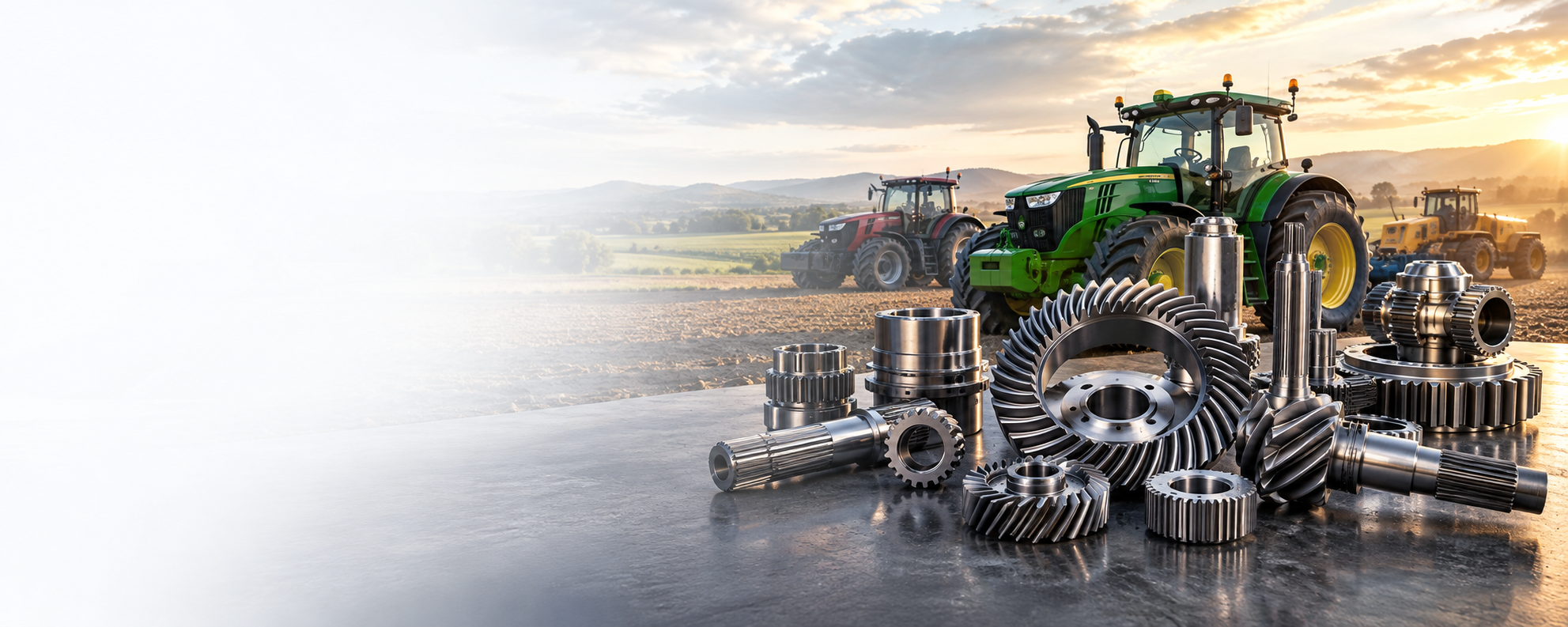
Speed gears and gear shafts are central components in a tractor transmission. Their job is to transfer torque through selected ratios while maintaining alignment with bearings, synchronizing elements and mating gears. Small differences in tooth form or shaft geometry can make apparently similar parts incompatible.
Speed gears: ratio and engagement
A speed gear works with another gear to establish a transmission ratio. Depending on the gearbox design, the gear may rotate freely until engaged, slide into position or work with a synchronizer or dog clutch. Tooth count, width, bore or spline and hub geometry all matter.
Gear shafts: support and torque transfer
A gear shaft supports rotating components and transfers torque between transmission stages. It may include splines, bearing journals, shoulders, threads and one or more integrated gear sections. Because the shaft interfaces with several components, dimensional confirmation can be especially important.
Key fields for B2B comparison
- OEM reference and alternate references
- Gearbanks product code
- Tractor or machine model
- Tooth count and gear position
- Spline or bore profile
- Overall width or shaft length
- Bearing and thread locations
- Mating gear or engagement component
Why transmission position matters
A gearbox can contain several gears with similar dimensions. Terms such as first, second, third, reverse, driven or countershaft describe where the component works. Supplying the transmission position together with the model and OEM number reduces ambiguity.
Use product data together
No single field should be treated as the only compatibility test. Use the OEM number as the primary search reference, then verify part name, tooth count and application. When a drawing or sample is available, it can be used to compare the remaining mechanical details before a production or supply decision.